Château
Château Cantenac Brown
How to read this
Capitals mark the stressed syllable. “ahn” is a nasal vowel: say it through the nose, with no n. The French r comes from the back of the throat. The recording is the reference.
A Tudor manor at Cantenac, classified in 1855 under the name Boyd, and since 2023 the home of a cellar built of raw earth, with concrete only in its foundations.
- Appellation
Margaux - On Instagram
- @chateau_cantenac_brown
- Châteaux
- See it among the 629
The château
John Lewis Brown, a Bordeaux merchant of Scottish descent and a painter of animals, began the Tudor manor early in the 19th century and went under; the Paris bankers Fruitier and Gromard took the estate in 1843, and in 1855 it was classified as Château Boyd. Louis Armand Lalande restored the name Cantenac Brown in 1860 and extended the building. The estate has changed hands several times since: the Lawton and du Vivier families, then Rémy Martin, then AXA Millésimes from 1989, then Simon Halabi from 2006, and in December 2019 Tristan Le Lous and his brothers Briac and Guirec, of the family behind the Urgo laboratories. José Sanfins directed the estate and made the wine from 1989; Romain Courtier, who came from
The new cellar, designed by Philippe Madec, was finished in the summer of 2023, in time for that harvest. Its outer wall is rammed earth, 50 centimeters thick and 20 meters long, banded with 3 colors of earth brought from a quarry at Montpon-Ménestrol, about 100 kilometers away; inside are walls of compressed earth brick, cork and wood wool for insulation, a vault of local timber and paint made from wheat, with low carbon concrete only in the foundations. A geothermal well holds the barrel hall between 13 and 14 degrees with no air conditioning. Seventy stainless steel vats of 50 to 120 hectoliters replaced 33 older ones, and the wine moves by gravity.
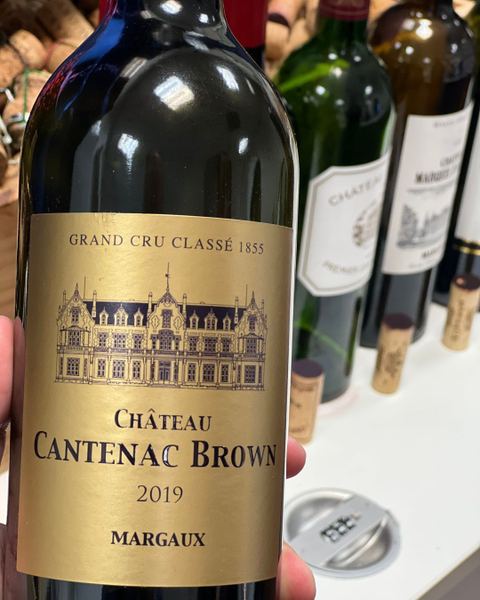
The vineyard is 75 hectares of red and 5 of white on Garonne gravel, planted 65% Cabernet Sauvignon, 33% Merlot and the rest Cabernet Franc and Petit Verdot, and 30 Scottish sheep graze a park that holds a sequoia 200 years old. Éric Boissenot consults. BriO de Cantenac Brown has been the second wine since 2001, and AltO the white since 2011. The 2019, which I tasted in September 2025, came from a near ideal year and showed it: fragrant and floral, the fruit layered, the structure polished and built to last. The white AltO 2019, which I tasted in May 2024, was fruit-forward and mineral, with elegant aromas of green apple and lemon.
At a glance
- Appellation
Margaux - Commune
- Cantenac
- Classification
- Troisième Cru Classé 1855, under the name Château Boyd
- Owners
- The Le Lous family, since December 2019
- Direction
- Romain Courtier, since 2026; José Sanfins, from 1989 to 2025
- Consultant
- Éric Boissenot
- Vineyard
- 75 hectares of red and 5 of white
- Soil
- Garonne gravel Terroir of
Margaux → - Grapes
- Cabernet Sauvignon 65%, Merlot 33%, the rest Cabernet Franc and Petit Verdot
- Cellar
- Raw earth, by Philippe Madec, finished in the summer of 2023; 70 stainless steel vats of 50 to 120 hectoliters; gravity fed
- Wines
Château Cantenac Brown ; BriO de Cantenac Brown, since 2001; AltO, white, since 2011- The park
- 30 Scottish sheep and a sequoia 200 years old
Sources
- Institutions
- Union des Grands Crus de Bordeaux,
Château Cantenac Brown ; amàco, the raw earth cellar ofChâteau Cantenac Brown - Press
- Decanter,
Château Cantenac Brown sold - Its own publications
Château Cantenac Brown , the estate
Revised October 13, 2026. How I choose sources
The record
The 1855 Classification was published on April 18, 1855, drawn up by the brokers of the Bordeaux exchange for the Exposition Universelle in Paris.
Private
By invitation only.
Also appears in
Tastings
1
In the news
2
-
Cantenac Brown hands the reins to Romain Courtier
Since early 2026, Romain Courtier has served as managing director of
Margaux Third GrowthChâteau Cantenac Brown , succeeding José Sanfins. -
Wine Advent #7: The Extraordinary Bottle of Cantenac Brown
Château Cantenac Brown has unveiled its “Terre & Temps” collection, featuring a double magnum containing the 2015 vintage.
Houses in its story
In the old books
“By tolerating no secondary grape variety there and admitting only the finest grape varieties, that is to say the carmenet-sauvignon, the carmenet franc and the petit-verdot.”
en n'y tolérant aucun cépage secondaire et en n'y admettant que les cépages les plus fins , c'est - à - dire le carmenet - sauvignon , le carmenet franc , et le petit verdot .
On from here
Test yourself on