Château
Château Léoville Poyferré
How to read this
Capitals mark the stressed syllable. The French r comes from the back of the throat. The recording is the reference.
The share of the old Léoville that took a baron’s name in 1840, in the Cuvelier family since 1920 and run today by its 5th generation.
- Appellation
Saint-Julien - Classification
- Deuxième Cru Classé 1855
- On Instagram
- @chateau_leovillepoyferre
- Châteaux
- See it among the 629
The château
The history of Léoville goes back to 1638, and for most of it there was no Poyferré, only one Léoville. William Franck, whose Traité sur les vins du
The Cuvelier family bought Léoville Poyferré and Moulin Riche from the Lawtons in 1920 and have held them since. Sara Lecompte Cuvelier took over as general director from her cousin Didier Cuvelier in 2018; Isabelle Davin is the château’s enologist and Didier Thomann the cellar master. The vineyard runs to 80 hectares of deep gravel along the Gironde, with Château Moulin Riche a single block of 20, the vines 38 years old on average, planted 68% Cabernet Sauvignon, 24% Merlot, 6% Cabernet Franc and 2% Petit Verdot. It has held Haute Valeur Environnementale (High Environmental Value, the French state’s environmental certification for farms), level 3, since the 2017 vintage. Pavillon de Léoville Poyferré is the second wine; Moulin Riche, established in 1885 on an older gravel terrace, is a wine of its own.
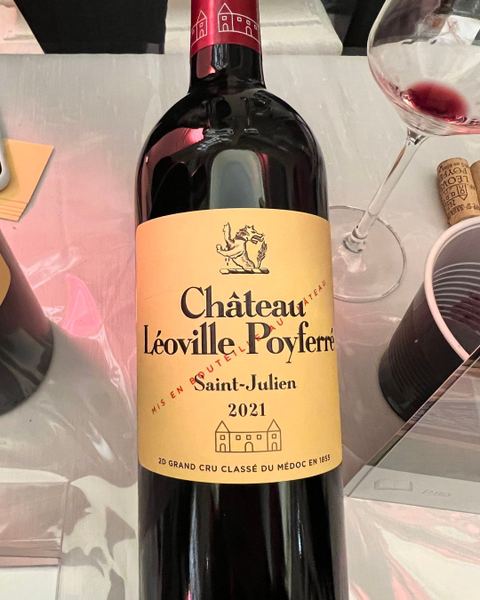
The style is polished and led by Cabernet, and a cool year shows it well. The 2021, which I tasted in October 2025, came out of a hard season of frost and mildew and made something classic of it: freshness, fine tannins, precise fruit and real elegance.
At a glance
- Appellation
Saint-Julien - Classification
- Deuxième Cru Classé 1855
- Owners
- The Cuvelier family, since 1920
- Direction
- Sara Lecompte Cuvelier, general director, since 2018; Didier Thomann, cellar master
- Enologist
- Isabelle Davin
- Vineyard
- 80 hectares, with Château Moulin Riche a single block of 20; vines 38 years old on average
- Soil
- Deep gravel along the Gironde Terroir of
Saint-Julien → - Grapes
- Cabernet Sauvignon 68%, Merlot 24%, Cabernet Franc 6%, Petit Verdot 2%
- Farming
- Haute Valeur Environnementale, level 3, since the 2017 vintage
- Wines
Château Léoville Poyferré ; Pavillon de Léoville Poyferré; Château Moulin Riche, a separate wine
Sources
- Institutions
- Union des Grands Crus de Bordeaux, Léoville Poyferré; CIVB, the classifications of 1855
- Press
- Decanter, the 3 Léovilles
- Its own publications
Château Léoville Poyferré : the property, the wines
Revised October 13, 2026. How I choose sources
The record
The 1855 Classification was published on April 18, 1855, drawn up by the brokers of the Bordeaux exchange for the Exposition Universelle in Paris.
Private
By invitation only.
Also appears in
Tastings
2

In the news
1
-
Bordeaux estates including
Château Léoville Poyferré , Cos d’Estournel andChâteau Valandraud are making kosher wines that retain the character of their terroir, according to The Jerusalem Post.Château Léoville Poyferré ’s kosher cuvée included the 2005 vintage.
Houses in its story
On from here
Test yourself on