Château
Château Cos Labory
How to read this
Capitals mark the stressed syllable. The French r comes from the back of the throat. The recording is the reference.
The neighbor of Cos d’Estournel across the road, bought in March 2023 by the owner of Cos d’Estournel, which put the 2 under the same owner for the first time since 1860.
- Appellation
Saint-Estèphe - Classification
- Cinquième Cru Classé 1855
- On Instagram
- @coslabory
- Châteaux
- See it among the 629
The château
The estate was called Cos-Gaston and takes its present name from François Labory, who held it until 1845. Louis Gaspard d’Estournel, the man who made Cos d’Estournel, bought it in 1847 and worked the 2 as a single holding, moving the best parcels from the smaller property to the larger; the English politician Charles Cecil Martyn bought Cos Labory in 1852, and the 2 were separated again in 1860. In the 20th century it belonged to the Weber family and passed by inheritance to the Audoys, who held it for more than 60 years. Bernard Audoy sold it in March 2023 to Michel Reybier, the owner of Cos d’Estournel, together with Château Andron Blanquet.
The 2 estates are neighbors across a road, and Reybier means to keep Cos Labory as an estate of its own rather than fold it into Cos d’Estournel. Angélique Vigouroux, who was cellar master at Cos d’Estournel, has been technical director here since 2023. With the 16 hectares of Andron Blanquet the vineyard runs to about 35, at 8,700 vines a hectare, with vines 38 years old on average and the oldest at the top of the plateau: 62% Cabernet Sauvignon, 26% Merlot, 10% Petit Verdot and 2% Cabernet Franc. Fermentation has been in temperature controlled stainless steel since 1999, and the wine is raised in both French and American oak, which is unusual here. Le Saint Estèphe de Cos Labory is the second wine.
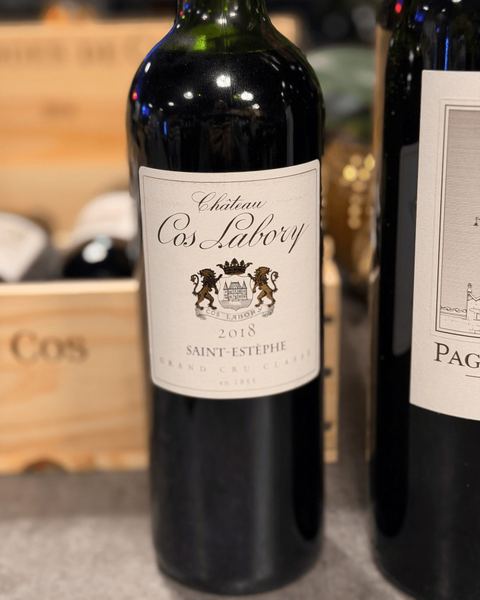
Cos Labory is easy to overlook, and it rewards those who do not. The 2018, which I tasted in January 2026, took a generous vintage and handled it with restraint: dark fruit, earthy notes and firm structure, nothing in excess, true to its place. The 2016, which I tasted in September 2026, was still dressed like a debutante a decade on, lovely already, with patience still to be repaid.
At a glance
- Appellation
Saint-Estèphe Terroir ofSaint-Estèphe →- Commune
Saint-Estèphe - Classification
- Cinquième Cru Classé 1855
- Owner
- Michel Reybier, owner of
Château Cos d’Estournel , since March 2023; the Audoy family before him - Direction
- Angélique Vigouroux, technical director, since 2023
- Vineyard
- About 35 hectares, with the 16 of Andron Blanquet; 8,700 vines a hectare; vines 38 years old on average
- Grapes
- Cabernet Sauvignon 62%, Merlot 26%, Petit Verdot 10%, Cabernet Franc 2%
- Cellar
- Temperature controlled stainless steel since 1999; French and American oak
- Wines
Château Cos Labory ; Le Saint Estèphe de Cos Labory- In history
- Held with Cos d’Estournel from 1847; separated in 1860
Sources
- Institutions
- Union des Grands Crus de Bordeaux,
Château Cos Labory - Press
- Wine Spectator, Michel Reybier expands his Bordeaux focus with
Château Cos Labory - Its own publications
Château Cos Labory , the estate
Revised October 1, 2026. How I choose sources
The record
The 1855 Classification was published on April 18, 1855, drawn up by the brokers of the Bordeaux exchange for the Exposition Universelle in Paris.
Private
By invitation only.
Also appears in
Tastings
1
In the news
1
-
Bordeaux 2025 Vintage Tastings: Starting Out Strong In St.-Estèphe
Wine Spectator’s early tastings of Bordeaux’s 2025 vintage began strongly in St.-Estèphe, where young wines from Cos d’Estournel, Cos Labory and
Château Tronquoy show how Bordeaux is evolving.
On from here
Test yourself on